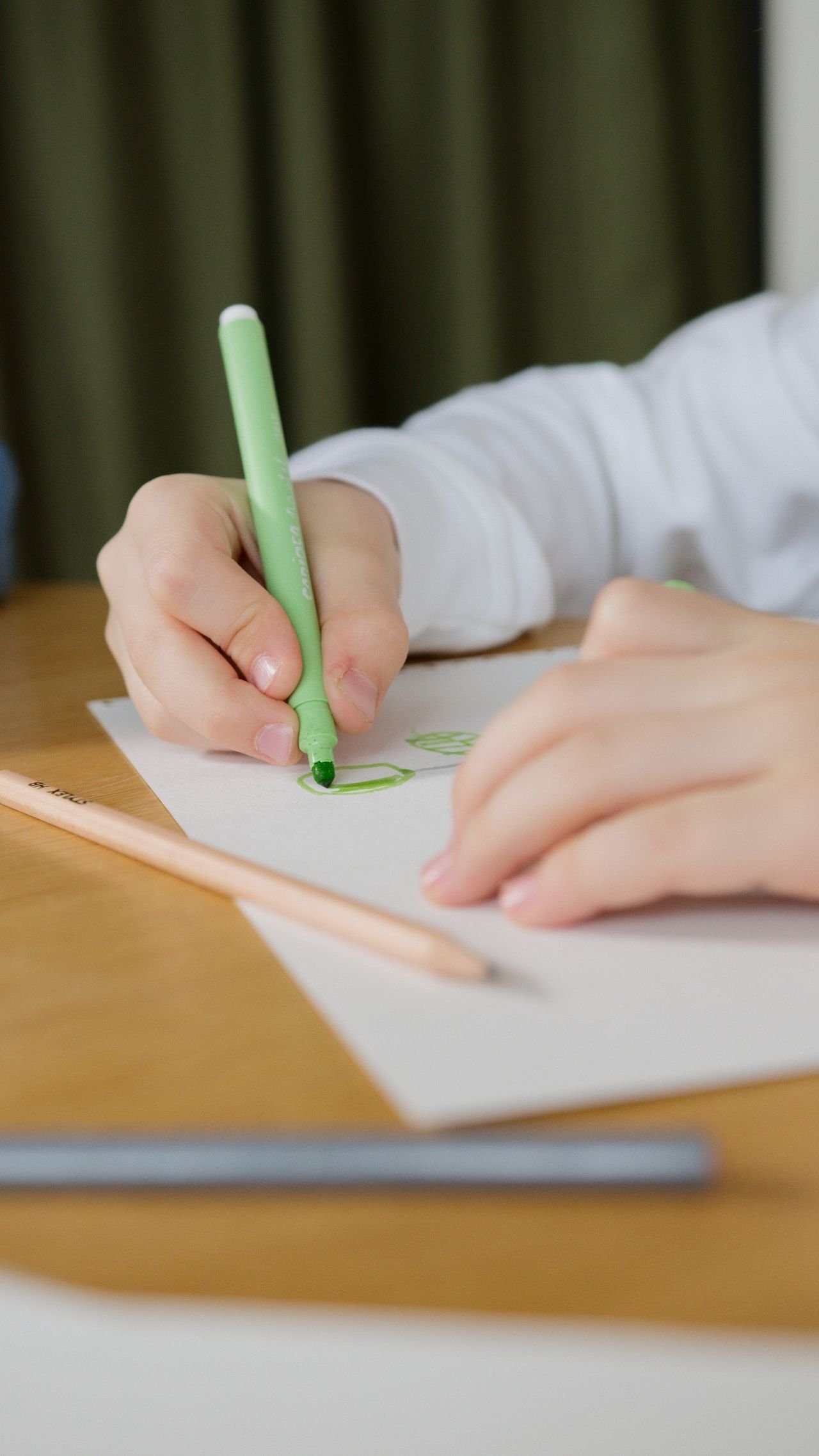
Handwriting difficulty in children is a pattern of effortful, tiring, or hard-to-read writing that is out of step with a child's age and ability, and it often has less to do with effort than with the physical and visual skills underneath writing. Pediatric occupational therapy looks at those underlying skills, such as hand strength, pencil control, posture, visual-motor coordination, and attention, and builds them in a way that fits the child.
Our licensed Occupational Therapists work with children across Vero Beach, Sebastian, and Fort Pierce, and handwriting is one of the most common concerns parents bring to us. Often, the child is bright and has plenty to say but cannot get it onto the page.
What is handwriting really made of?
Writing looks like a single skill, but it is a stack of them working together. A child has to hold the pencil, move the fingers and wrist with control, stay upright and stable, see and copy the shape of each letter, remember how to form it, and keep the pace of the class. Research reviews describe handwriting as drawing on motor, perceptual, and cognitive skills together, which is why it can break down in many different ways (Feder and Majnemer, Developmental Medicine and Child Neurology, 2007).
When one layer is weak, the whole task gets harder. A child with a tired, wobbly grip may write slowly. A child with weak core stability may slump and cover the page with their arm. A child with trouble seeing spacing may crowd letters together.
What are the signs that a child may need help?
Handwriting develops over several years, so some messiness in early grades is normal. These signs suggest it may be worth a closer look:
• An awkward or very tight pencil grip, or a child who complains their hand hurts
• Letters that are reversed, uneven in size, or poorly spaced well beyond the early grades
• Writing that is very slow, or a child who avoids written work
• Heavy pressure that tears paper, or very light writing that is hard to see
• Tiring quickly, rubbing the hand, or switching hands
• A big gap between what the child can say and what the child can write
None of these is a diagnosis. They are reasons to ask the question.
How does occupational therapy approach handwriting?
An occupational therapy evaluation begins with how your child actually writes, along with a look at the foundations. The therapist watches posture, grip, hand strength, coordination, and how your child copies shapes and letters. Then therapy builds what is missing, and it is designed to feel like play, not drills. If you are new to this, here is what pediatric OT looks like from start to finish.
Depending on the child, a session might include:
1. Core and shoulder stability work, because a steady trunk supports a steady hand.
2. Hand strengthening and finger control, through putty, tongs, clothespins, and similar play.
3. Pencil grasp and pressure, with tools and grips matched to the child.
4. Visual-motor practice, such as drawing shapes, mazes, and copying patterns.
5. Letter formation and spacing, taught with simple cues and repetition.
6. Self-regulation and attention, so a child can sit and focus long enough to write.
The evidence for therapy-based approaches is growing. A 2024 systematized review of occupational therapy interventions for school-aged children examined how OT can improve handwriting outcomes (University of Nebraska Medical Center, 2024). Every child is different, so we set goals for your child and measure progress over time.
Why not just practice writing more?
More practice helps only if the underlying skills are in place. If a child's grip is painful or their posture is unstable, extra worksheets can reinforce bad habits and make a child dislike writing. We find that building the foundation first, then practicing letters, is faster and kinder.
How can families support handwriting at home?
Home support works best when it is small, fun, and consistent. Some ideas:
• Play with tools that build hand strength: play dough, tongs, and building blocks.
• Try vertical surfaces: drawing on an easel or a wall builds shoulder stability.
• Use short bursts: five focused minutes beat a half hour of struggle.
• Make writing meaningful: a grocery list, a card for a relative, or a note on the fridge.
• Check the setup: feet supported, table at the right height, good lighting.
Many parents tell us they want to know exactly what to do between sessions. That is the idea behind our structured Parent Coaching program, which helps parents build skills into daily routines with guidance from a therapist.
Is financial support available?
We are a private-pay practice. We are also an approved provider for the Family Empowerment Scholarship for Students with Unique Abilities (FES-UA) through Step Up For Students. Eligibility is determined by the program, so families should check with Step Up For Students about their own situation, and our team is happy to talk through how it works.
Frequently asked questions
What is pediatric occupational therapy for handwriting? It is therapy that builds the physical, visual, and attention skills a child needs to write, such as grip, hand strength, posture, and visual-motor coordination. Sessions are play-based and tailored to the child.
At what age should I worry about my child's handwriting? Writing develops over several years, so some messiness in early grades is expected. If your child is in elementary school and writing is painful, very slow, or causing them to avoid schoolwork, it is a good time to ask for an evaluation.
Is messy handwriting a sign of a learning disability? Not always. It can be linked to motor, visual, or attention differences, or it may simply need more time to develop. An evaluation can help sort out the cause so you know the next step.
How long does handwriting therapy take? It depends on the child's starting point and goals. Your therapist will set goals, review progress regularly, and adjust the plan as your child improves.
Can I help my child at home without making it a chore? Yes. Play-based activities, short practice, and writing for real reasons all help. Your therapist can show you which activities fit your child.
Talk with our team
If your child is struggling to write, contact Vero Pediatric Therapy Services to talk with our team about next steps for your family.
About the authors
The Vero Pediatric Therapy Services Clinical Team is made up of licensed Occupational Therapists, BCBA-supervised ABA professionals, and licensed Speech-Language Pathologists serving families across Vero Beach, Sebastian, and Fort Pierce, FL, in Indian River and St. Lucie Counties on the Treasure Coast. We provide private-pay, family-centered, evidence-based pediatric therapy, along with a structured Parent Coaching program. Contact us at verotherapyservices.com/contact-us.