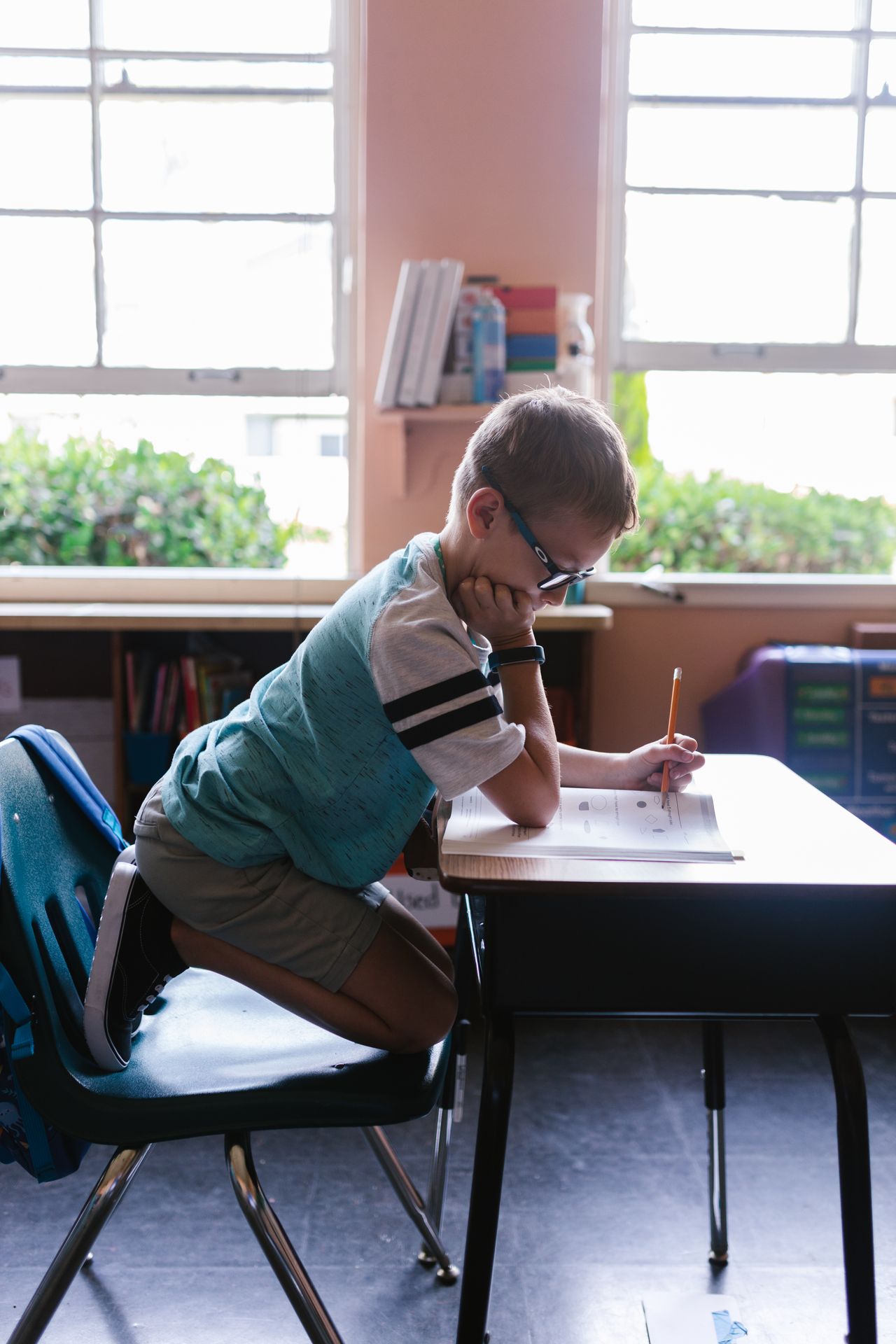
Sensory processing is how a child's nervous system takes in information from the environment and the body, organizes it, and produces a response. When that process works smoothly, a child can sit through a lesson in a noisy room without much effort. When it does not, the same room can be genuinely overwhelming, and the child's behavior is often the first thing anyone notices.
Now that classrooms across Indian River and St. Lucie Counties are back in session, this is the season when the phone starts ringing. A child who managed the summer beautifully is suddenly having meltdowns after school, refusing to go, or getting notes home about difficulty staying seated.
Why is a classroom hard on a child's sensory system?
Consider what a school day actually asks. Fluorescent lighting, twenty other bodies moving, a fire drill, a cafeteria at full volume, the smell of lunch, a scratchy uniform tag, sitting still for extended stretches, and transitions every forty minutes. A child whose system processes all of that efficiently filters most of it out. A child whose system does not has to work through every input, all day, while also learning to read.
Sensory processing differences are more common than many parents expect. A peer-reviewed study of 1,723 children ages 5 to 11 attending primary school found that 21.3 percent showed possible sensory processing difficulties (Nielsen and colleagues, 2021, published in the National Library of Medicine). Earlier research using parent report found that 5.3 percent of a kindergarten population met screening criteria for sensory processing disorder (Ahn and colleagues, 2004, American Journal of Occupational Therapy). Estimates vary with the measure used, which is why an individualized evaluation matters more than a percentage.
What does dysregulation look like at school?
It rarely announces itself as a sensory problem. It usually arrives described as a behavior problem, and the two look similar from the outside. Common presentations include:
• Constant movement: rocking, leg bouncing, leaving the seat, seeking to crash into things
• Covering ears, avoiding the cafeteria or assemblies, or asking to leave the room
• Slumping over the desk, leaning on walls, or appearing tired and unfocused
• Big reactions to small events, particularly during transitions and unstructured time
• Distress over clothing, tags, socks, shoes, or having hands messy
• Distraction by sounds most children have stopped noticing, like the air conditioner or hallway traffic
• Holding it together all day and falling apart the moment they get in the car
That last pattern deserves its own mention, because it is the one most often missed. A child who is regulating with enormous effort at school may look fine to the teacher and have nothing left by three o'clock. Parents describing after-school meltdowns are frequently describing a sensory load, not a discipline issue.
This is where an occupational therapy lens changes the conversation. Instead of asking why a child is behaving this way, it asks what the child's nervous system is trying to do, which is generally to get more input or less of it. Understanding what pediatric occupational therapy actually addresses helps families see why the same clinician who works on handwriting also works on a child's ability to sit through circle time.
How does occupational therapy help?
OT for sensory regulation is practical and individualized. It starts by identifying which systems are involved and in which direction, because a child who seeks movement needs the opposite support from a child who is overwhelmed by it. Two children with the same classroom behavior can need very different plans.
From there, our licensed Occupational Therapists typically work on:
1. Building the child's own regulation skills. Recognizing the feeling of being overwhelmed or under-alert, and knowing what helps.
2. Embedding sensory input into the day. Heavy work such as carrying, pushing, and climbing, plus movement breaks scheduled before dysregulation rather than after.
3. Practical classroom accommodations. Flexible seating, a quieter workspace for testing, noise-reducing headphones for the cafeteria, a fidget that is actually allowed.
4. Transition and routine supports. Advance warnings, visual schedules, and predictable sequences, since transitions are where most classroom difficulties concentrate.
5. Underlying postural and motor work. A child who lacks core strength will keep shifting in a chair, and no amount of reminding will change that.
6. Coaching the adults. Parents and teachers see the child far more than we do, so the plan has to be something they can run.
Families ready to see what that looks like in practice can learn how our pediatric occupational therapy program approaches evaluation and goal-setting for children in Vero Beach, Sebastian, and Fort Pierce. For children who also receive ABA services, our teams coordinate so that regulation goals and behavior goals reinforce each other rather than pulling in different directions.
What can families do right now?
Before an evaluation, a few things help almost every child. Protect the transition home with a quiet, low-demand window rather than immediate questions about the school day. Build in movement before homework rather than after. Watch for patterns in when difficulties cluster, since the timing usually points to the trigger. And talk with the teacher about what they observe, because the classroom picture and the home picture together are far more useful than either alone.
Frequently asked questions
What is sensory processing? Sensory processing is how the nervous system takes in information from the environment and the body, organizes it, and responds. When processing is inefficient, ordinary classroom input like noise, lighting, and movement can feel overwhelming or insufficient, which affects a child's ability to focus and participate.
Is my child's classroom behavior a sensory issue or a behavior issue? It can be both, and they often look identical from the outside. An occupational therapy evaluation helps identify whether the nervous system is seeking or avoiding input, which points to very different strategies than a purely behavioral approach.
Why does my child hold it together at school and melt down at home? Many children regulate with enormous effort throughout the school day and have no reserve left afterward. After-school meltdowns are frequently a sign of accumulated sensory and social load rather than a discipline problem.
Can occupational therapy help with sitting still and paying attention? Often yes, when the difficulty is related to sensory regulation, postural strength, or motor control. Therapy addresses the underlying systems and builds strategies the child can use in the classroom rather than simply asking the child to try harder.
Does my child need a diagnosis before an occupational therapy evaluation? No. Families can pursue a pediatric occupational therapy evaluation based on their own concerns or a teacher's observations, and the evaluation itself describes the child's strengths and challenges.
How do school accommodations and private therapy work together? Private therapy focuses on building the child's underlying skills, while classroom accommodations reduce the demand during the school day. The two work best in combination, with strategies shared between the therapist, the family, and the teacher.
Support your child's school year
If your child is struggling with the sensory demands of a classroom, an evaluation can turn a confusing pattern into a clear plan. To learn how occupational therapy could support your child this school year, contact Vero Pediatric Therapy Services.
About the authors
Vero Pediatric Therapy Services is a family-centered pediatric practice on Florida's Treasure Coast, staffed by licensed Occupational Therapists and BCBA-supervised ABA professionals. We provide private-pay, evidence-based occupational and ABA therapy to children and families across Vero Beach, Sebastian, and Fort Pierce, serving Indian River and St. Lucie Counties. To learn how we can help your child, contact our team.